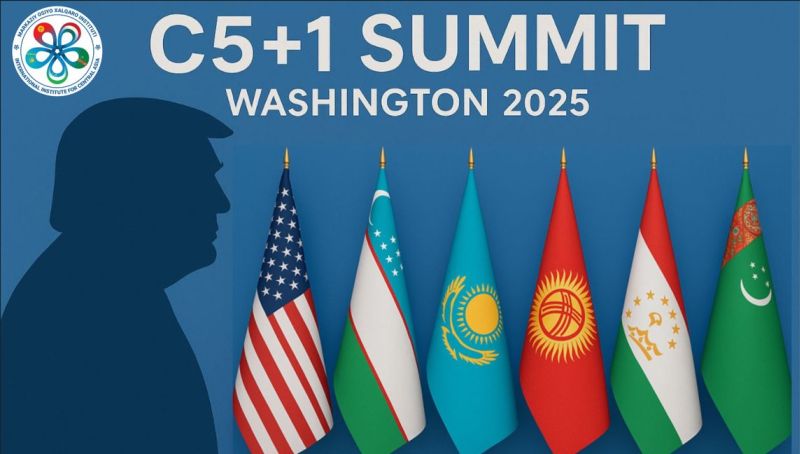
C5+1 Summit: Contradictory Outcomes
Prague, 10 November, Free Eurasia. The historic visit of the leaders of five Central Asian states — Kazakhstan, Uzbekistan, Kyrgyzstan, Tajikistan and Turkmenistan — to Washington on 6 November 2025 marked a significant event not only for the region but for Eurasian geopolitics as a whole. For the first time since its creation in 2015, the C5+1 platform — previously used mainly at the ministerial level — convened at the level of heads of state.
The summit’s main focus was economic and strategic cooperation aimed at reducing Central Asia’s dependence on China and Russia. Washington outlined its priority: critical minerals — including uranium and rare earth elements — vital for producing high-tech components, weaponry and batteries.
Betting on Resources and Investment
The summit resulted in an impressive package of agreements and memorandums worth more than $25 billion. Kazakhstan emerged as the primary beneficiary of U.S. interest: over 30 deals were signed totaling about $17.2 billion, including a $1.1 billion contract to develop one of the world’s largest tungsten deposits, 70% of the revenue from which will go to an American company.
Uzbekistan, for its part, announced plans to purchase U.S. goods and services worth $100 billion over the next ten years.
The total value of contracts signed between Tajikistan and the United States exceeds $3 billion.
According to Tajikistan’s Foreign Ministry, the key document was an agreement between Tajik airline Somon Air and Boeing on the purchase of 14 aircraft — 787 Dreamliner and 737 MAX models — as well as aviation equipment, with a total value of $3.2 billion.
Tajikistan also signed a cooperation agreement with the U.S. company Transparent Earth, which specializes in satellite technologies for natural resource mapping and sustainable exploration. The contract amounts to $32.5 million.
Another area of cooperation will be the integration of Tajikistan into the Starlink satellite internet network, a subsidiary of Elon Musk’s SpaceX. Tajik authorities also reached agreements with Perplexity AI and Zypl AI to introduce artificial intelligence solutions into the system of state governance.
Meanwhile, Coca-Cola announced plans to invest an additional $9 million in expanding its operations in Tajikistan.
Civil aviation agreements were also a notable part of the summit. Kazakhstan, Uzbekistan and Tajikistan signed deals with Boeing for the purchase of more than 40 aircraft, including Dreamliner 787-9 and 737 MAX models.
Regional media note that these agreements aim not only to emphasize the economic element of the summit but also to demonstrate the region’s aspirations toward infrastructure modernization and improved transportation networks.
The Abraham Accords
Beyond economic cooperation, the summit also addressed the possibility of Central Asian states joining the Abraham Accords.
However, Kazakhstan was the only country that joined the initiative.
Commenting on Astana’s decision, U.S. President Donald Trump wrote on Truth Social:
“Kazakhstan is the first country to join the Abraham Accords in my second term, and this is just the beginning. This step will become an important bridge bringing nations closer together. We’ll soon announce the date of the official signing ceremony, and many more countries will want to join this peace-building club.”
According to Sarah Zaaimi, an analyst at the Atlantic Council, the inclusion of countries such as Kazakhstan and potentially Azerbaijan — both possessing gas and uranium reserves and access to the Caspian Sea — would give the United States and Israel a strategic advantage over Russia and Iran in the Caspian region.
The participation of Kazakhstan, and possibly Azerbaijan, in the Abraham Accords opens access to energy resources, uranium and key transit corridors connecting Europe and Asia while bypassing Russia and Iran. This strengthens U.S. and Israeli influence in a space traditionally dominated by Moscow and Tehran, and creates a new pro-American balance through economic, technological and diplomatic cooperation with moderate Muslim countries.
A “Deal” Over Civil Liberties?
The summit demonstrated that, unlike the rhetoric of the Obama or Biden eras — when attention was focused on democracy and human rights — Washington’s current strategy is markedly pragmatic.
The priorities were business, resources, security and maintaining a geopolitical balance with Beijing and Moscow.
Human rights and civil society issues were mentioned but were clearly not the focus of the meeting — despite the fact that all Central Asian countries continue to face significant restrictions on freedoms. Kazakhstan and Uzbekistan show signs of partial liberalization, but opposition and media remain tightly controlled. Kyrgyzstan, once the most open country in the region, is sliding back toward authoritarianism. Tajikistan and Turkmenistan remain the most restrictive — with persecution of the opposition, censorship and the absence of political competition.
For many regional governments operating in authoritarian systems, this shift comes as a relief: Washington today talks less about reforms and more about contracts.
Between Three Centers of Power
The C5+1 summit also showed that Central Asia is no longer a “periphery” of world politics. The United States seeks to offer the region an alternative to China’s Belt and Road Initiative and to counter Beijing’s and Moscow’s influence, both of which have weakened amid sanctions and the war in Ukraine.
For Central Asian states, this presents a rare opportunity to balance between three major powers — Moscow, Beijing and Washington — and choose the most profitable path of cooperation.
If the announced agreements are implemented, the region may gain not only new investments and technologies but also a rare chance to strengthen its sovereignty amid rising global tensions.
However, according to experts from CSIS and the Atlantic Council, the long-term success of the U.S. strategy will depend not on the volume of declared contracts, but on Washington’s ability to build a stable political presence in a region where investment is constrained by institutional and legal risks.
Corruption, weak property protections, authoritarian governance and the influence of Russia and China create an atmosphere of uncertainty for business. And business, as is well known, prefers stability.
Islam Tekushev, Free Eurasia