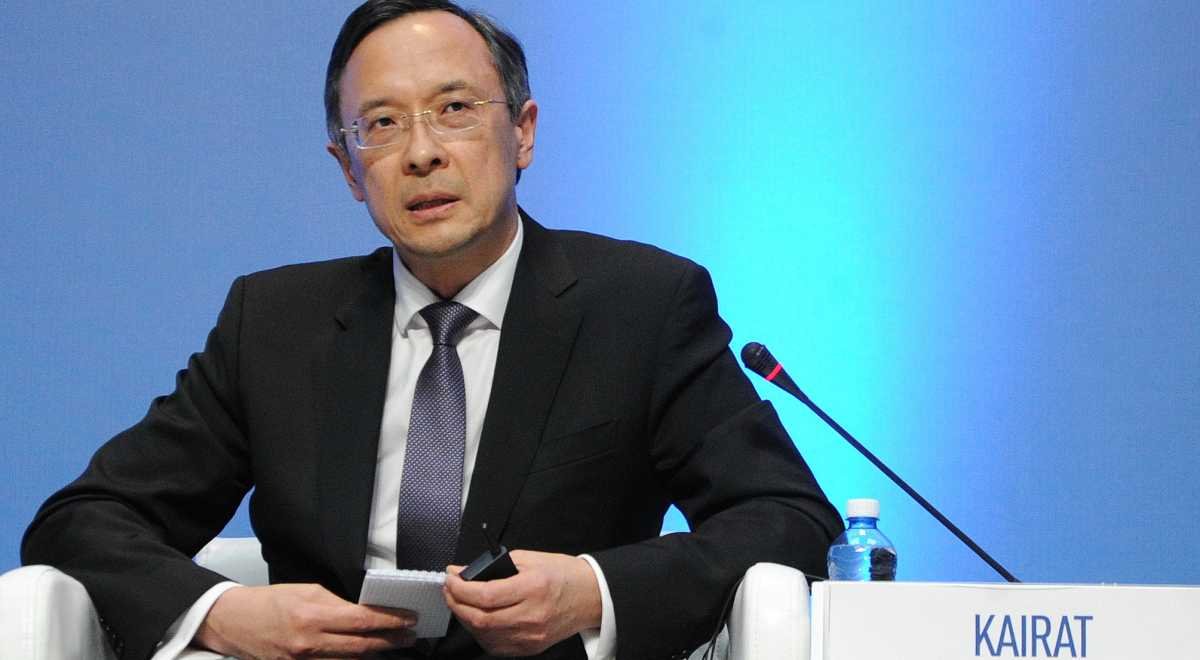
Kairat Abdrakhmanov, Kazakhstan’s Ambassador: The World Needs No New Dividing Lines
Prague, Free Eurasia, 23 November. Interview with Kairat Abdrakhmanov, Ambassador of the Republic of Kazakhstan to the Czech Republic.
Free Eurasia: On 28 October 2026, President Kassym-Jomart Tokayev delivered his State of the Nation Address entitled “Kazakhstan’s Current Priorities in a New Historical Cycle”. The Address comes at a time of profound changes in international relations, growing geopolitical tensions and increasing uncertainty in the global economy. How do you interpret its main message in the broader international context?
Ambassador Kairat Abdrakhmanov: I believe the Address should be viewed not merely as a programme of domestic economic reforms, but also as a strategic vision of Kazakhstan’s place in a rapidly changing international environment.
The President offered a frank assessment of the current state of international affairs, drawing attention to the growing crisis of trust among major powers, intensifying geopolitical confrontation, the weakening authority of the United Nations and the erosion of international law. These developments create an increasingly unpredictable environment, particularly for countries whose security and prosperity depend on stable international relations and an open global economy.
For Kazakhstan, the fundamental conclusion is clear: strengthening national sovereignty and maintaining strategic independence require a strong economy, modern infrastructure, technological development and social stability.
This is especially important as Kazakhstan marks the 35th anniversary of its independence and embarks on a new stage of political and institutional transformation following the adoption of the new Constitution.
The President’s vision of a “Just, Strong, Clean and Progressive Kazakhstan” is therefore closely connected with the country’s ambition to become a technologically advanced, economically competitive state with a meaningful geopolitical role and a strong international standing.
Free Eurasia: President Tokayev has repeatedly emphasised Kazakhstan’s commitment to a balanced and constructive foreign policy. Against the backdrop of growing competition between major powers, particularly in Eurasia, how does Kazakhstan intend to preserve its strategic independence?
Ambassador: Kazakhstan’s geographical position is a permanent factor in its foreign policy. We are situated at the heart of Eurasia, sharing borders with two major global powers, Russia and China, while maintaining close and expanding relations with Europe, the United States, the countries of Central Asia and other international partners.
We do not regard this geographical reality as a limitation. On the contrary, it creates opportunities for mutually beneficial cooperation, provided that all partners respect Kazakhstan’s sovereignty, independence and national interests.
Our approach is based on the principles of pragmatism, mutual respect and the peaceful resolution of international disputes. Kazakhstan is not interested in geopolitical confrontation or the division of the world into competing blocs. We believe that international cooperation should be based on the recognition of the legitimate interests of all states.
Strategic independence, in our understanding, does not mean isolation or distancing ourselves from international partners. It means having the economic capacity, institutional strength and diplomatic flexibility to make independent decisions and pursue mutually beneficial partnerships.
This is precisely why the President places such emphasis on economic diversification, domestic industrial capacity, technological development and the protection of critical infrastructure. A country that is overly dependent on a limited number of markets, transport routes or external suppliers inevitably faces additional vulnerabilities.
Our objective is to transform Kazakhstan’s geographical position and resource potential into sustainable economic advantages while preserving the freedom to pursue an independent foreign policy.
Free Eurasia: One of the most interesting aspects of the Address concerns the development of transport and logistics infrastructure. President Tokayev has called for Kazakhstan to become not simply a transit territory, but a fully fledged organiser of international freight flows. Is this primarily an economic objective, or does it also have a geopolitical dimension?
Ambassador: It is both, and the two dimensions are increasingly inseparable.
Global logistics is undergoing a fundamental transformation. Disruptions to traditional maritime routes, geopolitical tensions and the growing importance of supply chain resilience have increased the strategic value of reliable overland connections across Eurasia.
Kazakhstan has considerable advantages in this regard. Our territory connects major economic centres in Europe and Asia, and we are already an important element of the international transport network.
In his Address, the President highlighted the importance of the Trans-Caspian International Transport Route, the development of new railway connections and the modernisation of border crossings, roads and logistics infrastructure. In particular, the Bakhty-Ayagoz railway and the new Aral-Caspian transport corridor are intended to expand capacity and improve the efficiency of transcontinental transportation.
However, our ambitions go beyond the simple transit of goods. We want to develop domestic logistics operators, distribution centres, industrial facilities and trading hubs around major transport junctions. In other words, Kazakhstan intends to become an active participant in the organisation of international supply chains and the creation of added value.
This approach is also relevant to Europe. The development of reliable and diversified connections between European and Asian markets serves the interests of both sides. For the European Union and individual European countries, including the Czech Republic, Kazakhstan represents an important partner in strengthening Eurasian connectivity.
At the same time, connectivity should not be viewed exclusively through the prism of competition between major powers. Infrastructure can become an instrument of economic interdependence and cooperation rather than geopolitical division.
Free Eurasia: Energy security has become one of the central issues of international politics. Kazakhstan is an important producer of hydrocarbons and uranium, while the President has also emphasised the need to expand electricity generation and develop nuclear energy. What is Kazakhstan’s long-term vision in this field?
Ambassador: Energy security is an essential component of national sovereignty and economic competitiveness.
The President’s Address makes an important point: in the era of artificial intelligence, digitalisation and advanced manufacturing, access to reliable and affordable electricity is becoming a decisive factor in economic development. Kazakhstan has set itself an ambitious objective of achieving a sustained electricity surplus by 2029.
Kazakhstan has substantial energy resources, but we must ensure that our resource potential is translated into a modern, diversified and sustainable energy system. This requires new generating capacity, the modernisation of existing infrastructure, the development of renewable energy and the responsible use of our traditional energy resources.
Nuclear energy is an important element of our long-term strategy. Kazakhstan possesses significant uranium resources and has accumulated considerable expertise in the nuclear fuel sector. Following the nationwide referendum, Kazakhstan decided to develop nuclear power plants. In his recent Address, President Tokayev specifically highlighted two major projects: the Balkhash Nuclear Power Plant, whose construction could begin as early as 2027, and the Moyinkum Nuclear Power Plant, for which he called for accelerating preparations and concluding a comprehensive cooperation agreement to launch the project.
The President has also stressed that all international agreements in this area must be carefully negotiated in accordance with Kazakhstan’s national interests.
For us, energy cooperation is not simply about supplying resources to international markets. It is about building technological capabilities, strengthening energy independence and creating the conditions for industrial development. We are interested in developing international partnerships that go beyond the construction of individual facilities and include technology transfer, the development of high-tech industries and the capacity building.
There are also considerable opportunities for cooperation with European partners, including the Czech Republic, which has extensive industrial and technological expertise in the energy sector.
Free Eurasia: The Address also places considerable emphasis on critical minerals and the integration of Kazakhstan into global industrial value chains. With the growing competition among major economies for access to strategic resources, could this turn Kazakhstan into an increasingly important geopolitical actor?
Ambassador: Critical minerals are becoming an increasingly important factor in the global economy. Their significance extends far beyond the traditional mining sector, as they are essential for advanced manufacturing, digital technologies, artificial intelligence, renewable energy and modern industrial production.
Kazakhstan has considerable geological and mineral potential. However, our strategic objective is not simply to increase the extraction and export of raw materials.
As President Tokayev emphasised, we need to develop geological exploration using modern technologies, expand domestic processing, attract long-term investment and establish strategic partnerships with leading international companies.
In this context, integration into global production chains is particularly important. We want international cooperation to contribute to the development of local industrial capacity, the transfer of knowledge and technologies, and the training of qualified specialists.
This approach creates opportunities for mutually beneficial partnerships with both European and Asian economies.
For Kazakhstan, the diversification of international partnerships in the critical minerals sector is also a matter of economic resilience. We are interested in cooperating with different partners on the basis of commercial viability, technological expertise and respect for our national interests.
We believe that Kazakhstan can become a reliable long-term partner in building more resilient and diversified global supply chains.
Free Eurasia: Water scarcity is another issue with potentially serious consequences for regional stability, particularly in Central Asia. How does Kazakhstan intend to address this challenge, and what role should international cooperation play?
Ambassador: Water security is one of the most important strategic issues facing Central Asia. It is directly connected with food security, energy production, agriculture, environmental sustainability and the long-term development of our economies.
The transboundary nature of many regional water resources means that no country can effectively address these challenges on its own. Sustainable solutions require regular dialogue, reliable data exchange, coordinated water management and respect for the legitimate interests of all countries concerned.
President Tokayev has emphasised the need for a more responsible approach to water consumption, the modernisation of water infrastructure, the reduction of losses and the introduction of digital technologies for monitoring and managing water resources.
At the regional level, Kazakhstan supports strengthening cooperation among Central Asian countries and developing practical mechanisms for the rational and equitable use of transboundary water resources.
We also believe that the international community should pay greater attention to water security. Kazakhstan has previously proposed the establishment of an International Water Organisation under the auspices of the United Nations. We consider this initiative an opportunity to strengthen international coordination, facilitate the exchange of experience and promote practical solutions.
Water should be recognised as an essential component of global economic and human security, alongside energy and food resources.
Free Eurasia: The President has also declared the development of an AI-powered digital economy a strategic priority. Can technological modernisation become a new dimension of Kazakhstan’s international positioning, particularly in Central Asia?
Ambassador: Absolutely. Technology is no longer simply an instrument of economic development; it is becoming one of the principal determinants of national competitiveness, resilience and sovereignty.
The President’s initiative to implement the Digital Qazaqstan strategy reflects our intention to move beyond the digitalisation of individual public services towards the creation of a fully integrated digital economy.
Kazakhstan has already made considerable progress in electronic government, digital financial services and cashless payments. We are now developing the infrastructure necessary for more extensive applications of artificial intelligence, including supercomputing capacity, data centres and digital connectivity.
However, technological development must be accompanied by investment in people. Education, scientific research, professional training and the development of human capital are essential if we want technological progress to translate into sustainable economic growth.
We also see considerable opportunities for regional cooperation in Central Asia. The exchange of technological expertise, the development of digital infrastructure, cooperation in cybersecurity and the training of specialists can strengthen the competitiveness of the entire region.
Our ambition is not to compete with the world’s largest technological powers in every field, but to become an active participant in the emerging digital economy and a regional centre for technological cooperation.
Free Eurasia: Returning to the international dimension, the President has expressed concern about the weakening of international law and the declining authority of the United Nations. What role can countries such as Kazakhstan play in preserving the international system and preventing further fragmentation?
Ambassador: We believe that the existing international system, despite its shortcomings, remains indispensable. The United Nations Charter, the principles of sovereignty, territorial integrity, peaceful settlement of disputes and non-interference in internal affairs provide the fundamental legal framework for relations among states.
The weakening of international law creates additional risks, particularly for medium-sized and developing countries. In a world where the rules become less predictable, the ability of states to protect their sovereignty and pursue independent policies becomes increasingly important.
Kazakhstan has consistently advocated dialogue, multilateralism and the strengthening of international institutions. Our foreign policy experience demonstrates that even in difficult geopolitical circumstances, it is possible to maintain constructive relations with different partners and contribute to international dialogue.
We believe that the international community needs more effective mechanisms for addressing common challenges, whether they concern regional security, nuclear non-proliferation, climate change, water resources, food security or technological development.
Kazakhstan is prepared to contribute to these efforts through its participation in international organisations and regional cooperation formats, as well as by promoting initiatives aimed at strengthening trust and practical cooperation.
The world does not need additional dividing lines. It needs more dialogue, more responsible diplomacy and a renewed commitment to the principles of international law.
Free Eurasia: Finally, what message would you convey to European partners, particularly the Czech Republic, in light of the priorities outlined in President Tokayev’s Address?
Ambassador: My message is that Kazakhstan views Europe not only as an important economic partner, but also as an essential participant in shaping the future of the Eurasian continent.
The Czech Republic and Kazakhstan have developed constructive political relations and a solid foundation for economic cooperation. We see significant opportunities to expand our partnership in industrial production, engineering, energy, transport and logistics, critical minerals, digital technologies, agriculture and education.
President Tokayev’s Address provides an important framework for identifying new areas of cooperation. Our priority is to attract not only investment, but also advanced technologies, expertise and opportunities for developing local production and human capital.
We are particularly interested in partnerships that create long-term economic value for both sides.
At the same time, I would emphasise that a stable and prosperous Central Asia is in the broader interest of Europe. Regional connectivity, sustainable water management, energy security and economic development are not isolated regional issues. They are closely linked to the stability and prosperity of the wider Eurasian space.
Kazakhstan is ready to continue working with the Czech Republic, the European Union and other international partners to promote a more connected, stable and economically resilient Eurasia.
Ultimately, our strategic objective is to build a strong, independent and prosperous Kazakhstan that contributes constructively to regional stability and international cooperation.