
QazETA: Why Moscow Sought Clarification — and How Russia Introduced RuID
PRAGUE, October 24, Free Eurasia. Kazakhstan has introduced QazETA, an electronic travel authorization for citizens of visa-free countries, including members of the Eurasian Economic Union (EAEU). The new system will affect citizens of 85 countries. Its introduction has prompted questions from Moscow, although Russia introduced a similar advance notification system for foreign nationals a year earlier.
Moscow’s response
At a press briefing in Moscow on October 21, 2026, Russian Foreign Ministry spokeswoman Maria Vladimirovna Zakharova, answering a question about Kazakhstan’s new entry rules, said Moscow respected Astana’s right to improve its migration legislation but expected clarification on how QazETA would apply to citizens of EAEU countries. She said the clarification was needed to inform citizens in a timely manner and ensure that travel, work, business and humanitarian ties could continue without obstacles.
Russia itself began introducing a similar advance notification system earlier. In 2025, under an experiment, visa-free foreign visitors could report their trip in advance through the RuID app. At that stage, registration was voluntary for citizens of Kazakhstan. Russia also expanded biometric data collection at border checkpoints.
Russian authorities said the measures were intended to create a digital profile for foreign nationals and improve migration policy. In a decree signed in Moscow on July 9, 2025, Russian President Vladimir Vladimirovich Putin set out the aims of the digital profile: state security, law and order, and the regulation of migration based on complete and up-to-date information.
In response to Moscow’s request, Kazakhstan’s Foreign Ministry said it had already shared information about QazETA with the countries affected by the new rules through diplomatic channels.
By the time this article was published, the ministry had also posted explanations on the websites of Kazakhstan’s diplomatic missions.
What is QazETA?
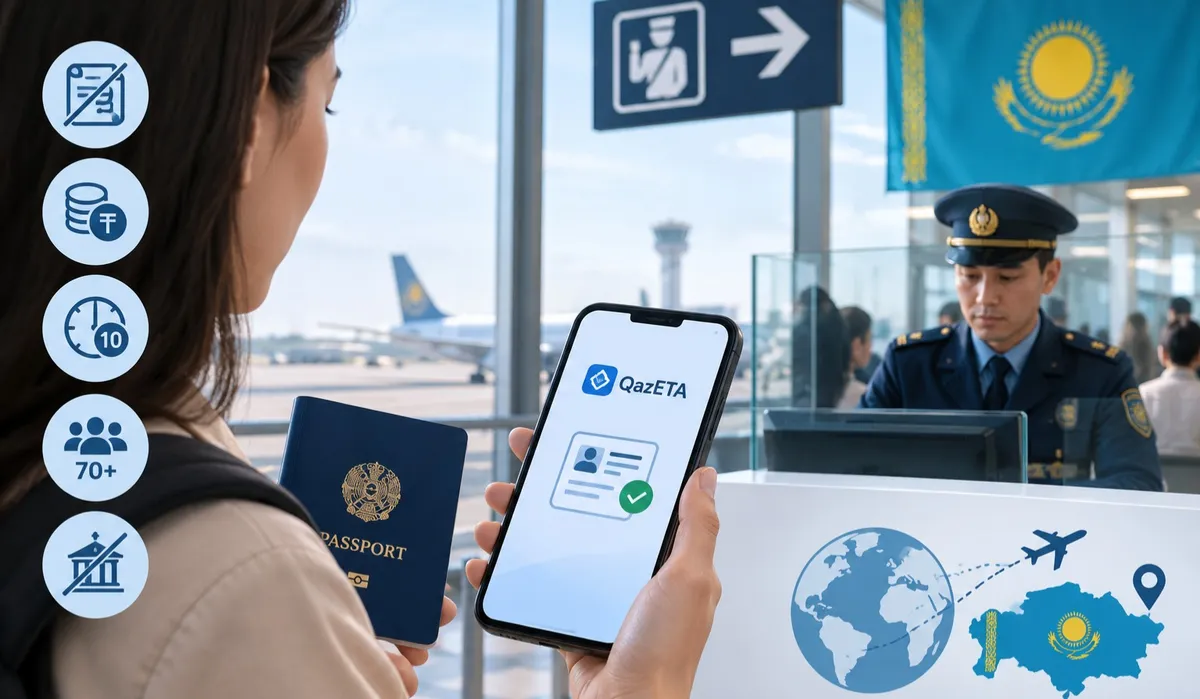
QazETA is an electronic authorization for travelers from visa-free countries. An application must be submitted through the app no later than 72 hours before travel. The authorization is valid for 180 days but does not guarantee entry: the final decision remains with the border service. Applying is free.
In an explanation posted on gov.kz on October 21, 2026, Kazakhstan’s embassy in Malaysia said the system was intended to make border checks more transparent, convenient and predictable for travelers.
The official schedule provides for several stages of checks: from November 1, 2026, at Aktau Airport and four land checkpoints; from January 1, 2027, at the airports in Astana and Almaty; and from March 1 at the remaining checkpoints. Until June 30, 2027, the absence of QazETA alone will not be grounds for refusing entry. The authorization will become mandatory on July 1, 2027. Kazakh authorities have also published a list of people exempt from applying, including children under 16, people over 65 and passengers who remain in an airport transit zone.
Kazakhstan and Russia’s membership in the EAEU simplifies employment conditions for their citizens: they do not need work permits in other member states. This does not mean there are no border checks or that all migration procedures are waived. The requirement to submit an electronic application alone is not enough to conclude that Kazakhstan is violating EAEU agreements.
The key question is how QazETA will work in practice: will it remain a pre-arrival notification procedure, or will it become an additional condition that could prevent citizens of EAEU countries from traveling? That is why Moscow has asked for clarification on how the new rules will be applied.
In experts’ view, the main concern for Moscow may be the data collection system. Russia’s system includes biometric data collection and the creation of a digital profile for each foreign national. At this stage, QazETA involves only an application form for entry. What changes may be introduced in the future remains unknown.
Kazakhstan still needs to explain how the system will operate, and its real effects will become clear once checks begin. For now, social media users are asking how the new rules will affect travel across the land border, a particularly pressing issue for residents of border areas in Kazakhstan and Russia.

