Kazakhstan: Extradition Detention as a Tool of Repression
PRAGUE, October 11 — Free Eurasia. The case of Yulia Yemelyanova and the experiences of other activists who have been denied protection in Kazakhstan have exposed a political and legal dilemma that Astana faces whenever it receives another extradition request from a “friendly country,” particularly when the individuals concerned are civil society activists.
On the one hand, when Kazakhstan receives an extradition request from Russia, for example, Astana is expected to act within the framework of mutual legal assistance agreements that allow for detention. On the other hand, Kazakhstan must comply with its international obligations, including the prohibition against returning individuals to countries where they may face persecution or torture.
Yet whenever another request is submitted for the extradition of a political exile or opposition activist, Astana responds by making an arrest and initiating the legal procedures prescribed for such cases.
According to human rights defenders, in nine out of ten cases Kazakhstan ultimately avoids extradition, but the individuals concerned are nevertheless subjected to prolonged restrictions on their liberty. In these cases, the Kazakh authorities place those sought for extradition in detention, which can last for up to a year. At best, the final outcome of these legal ordeals is a forced relocation to a third country, often facilitated by international human rights organizations and United Nations bodies.
Human rights defenders argue that, over the past several years, Kazakhstan has developed a practice in which its authorities effectively participate in transnational repression initiated by neighboring states against their own political activists and journalists.
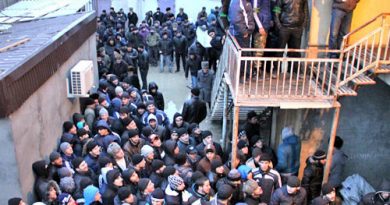
This practice is not new. One need only recall the cases of Karakalpak activists whose extradition was sought by the Uzbek authorities following mass protests in Nukus on July 1–2, 2022. Most of the detained Karakalpak activists spent months in extradition detention in Kazakhstan before being released and given an opportunity to seek protection in third countries. In February 2026, it became known that Rasul Zhumaniyazov, the last remaining member of this group of Karakalpak activists known to Freedom for Eurasia, had left Kazakhstan.
The practice of transnational persecution of civil society activists on Kazakh territory intensified significantly following Russia’s full-scale invasion of Ukraine and the subsequent influx of Russian political exiles into Kazakhstan.
Yulia Yemelyanova’s case is just one example of this practice. However, it has one particularly significant feature: Yemelyanova was detained on August 31, 2025, at Almaty International Airport while changing flights on her way from Georgia to Vietnam. In other words, she was in Kazakhstan solely as a transit passenger.
Since the beginning of Russia’s full-scale war against Ukraine, international human rights organizations have repeatedly drawn attention to the detention in Kazakhstan of Russian emigrants and activists from other Central Asian countries.
However, it is difficult to establish the exact number of people arrested in Kazakhstan in response to extradition requests that human rights organizations consider politically motivated. Available reports do not provide comprehensive statistics that would make it possible to distinguish ordinary criminal extradition cases from cases involving political persecution. It is also important to distinguish between extradition, deportation, and voluntary return. These are different procedures, although each may raise questions about compliance with the principle of non-refoulement.
One example is the case of Rinat Utambetov, a Karakalpak activist who agreed to return to Uzbekistan after being detained in Kazakhstan. According to Freedom for Eurasia, representatives of the Uzbek authorities assured him that he would not be imprisoned. However, after his return, the activist was arrested and, in 2025, sentenced to more than two years in prison.
Nevertheless, thanks to the work of human rights organizations that publicize cases involving the detention of political exiles, it is possible to identify, with a reasonable degree of confidence, an established pattern in how the Kazakh authorities respond to requests for their extradition.
One of the earliest cases involved Mikhail Zhilin, a former officer of Russia’s Federal Protective Service (FSO), who fled to Kazakhstan in the autumn of 2022 following the announcement of mobilization. Zhilin sought political asylum. He feared returning to Russia, where he faced criminal prosecution for desertion and illegally crossing the border.
Despite appeals from lawyers and human rights defenders, Kazakh authorities deported Zhilin to Russia on the night of December 29–30, 2022. After being handed over to Russian law enforcement agencies, he was placed in a pretrial detention center.
Human rights defender Yevgeny Zhovtis, who at the time headed the Kazakhstan International Bureau for Human Rights and Rule of Law, stated that Kazakhstan had an opportunity to avoid returning Zhilin to Russia. Germany and France had issued him humanitarian visas that would have allowed him to travel to a third country. Nevertheless, the Kazakh authorities decided to hand him over to Russia.
The case of Chechen activist Mansur Movlayev has also attracted international attention.
He has been held in extradition detention in Kazakhstan since May 2025. Russian authorities are seeking his extradition on extortion charges, while Movlayev himself maintains that the criminal case against him was fabricated.
The activist has previously reported abductions and torture by Chechen security forces. Human rights defenders warn that returning him to Chechnya could pose a serious threat to his life. On September 10, a cassation court rejected the Chechen activist’s appeal in his asylum case in Kazakhstan.
On October 5, a UN committee once again reminded Kazakhstan of the need to refrain from transferring the activist to Russia. It also warned that failure to comply with interim measures could result in a finding that Kazakhstan had violated its obligations under the Optional Protocol to the International Covenant on Civil and Political Rights.
The cases of these individuals raise an obvious question: To what extent is Kazakhstan, which has become one of the main destinations for Russian emigrants since the beginning of the war in Ukraine, capable of providing protection to people persecuted for political reasons?
Kazakhstan has bilateral extradition agreements with more than 24 countries, including Russia, China, the United Arab Emirates, and several European and Asian states. At the same time, Kazakhstan is bound by international obligations prohibiting the extradition of foreign nationals to countries where they face a risk of torture. Kazakhstan is a party to the UN Convention against Torture, the Convention Relating to the Status of Refugees, and the International Covenant on Civil and Political Rights. These instruments require compliance with the principle of non-refoulement: individuals must not be returned to countries where they face torture, while refugees must also be protected against return to places where they face persecution on grounds covered by the Refugee Convention, including political opinion. Mutual legal assistance agreements do not exempt Astana from these obligations.
Since the beginning of Russia’s full-scale military invasion of Ukraine, more than 20 Russian citizens detained in Kazakhstan have sought assistance from the Kazakhstan Bureau for Human Rights. According to Radio Free Europe/Radio Liberty, none of them received refugee status, although most managed to leave for third countries.
In 2025, human rights defenders managed to facilitate the transfer of six Russian servicemen who had fled mobilization from Kazakhstan to France. They obtained European visas and reached France, where they applied for political asylum.
Thus, the Kazakh authorities appear to be attempting to balance two contradictory approaches: fulfilling their international human rights obligations on the one hand, while engaging in practices that undermine those very rights on the other.
The case of Yulia Yemelyanova has clearly demonstrated that the risk of detention and subsequent extradition may arise even when a person is merely transiting through Kazakhstan.
An important question remains unanswered: Does this case indicate that the practice is expanding the circle of potentially vulnerable individuals, placing not only political exiles residing in Kazakhstan but also Russian citizens traveling through the country at risk of arrest if they have been placed on wanted lists by Russian authorities in connection with politically motivated criminal cases?
And do these cases demonstrate that mechanisms of international criminal justice cooperation can be used to persecute individuals for their opposition activities, public criticism of the authorities, or independent journalistic work?
Whatever the answers to these questions, Kazakhstan already risks establishing a reputation as a state involved in transnational repression initiated by the authorities of Russia and other countries with which it has concluded relevant agreements.
Free Eurasia